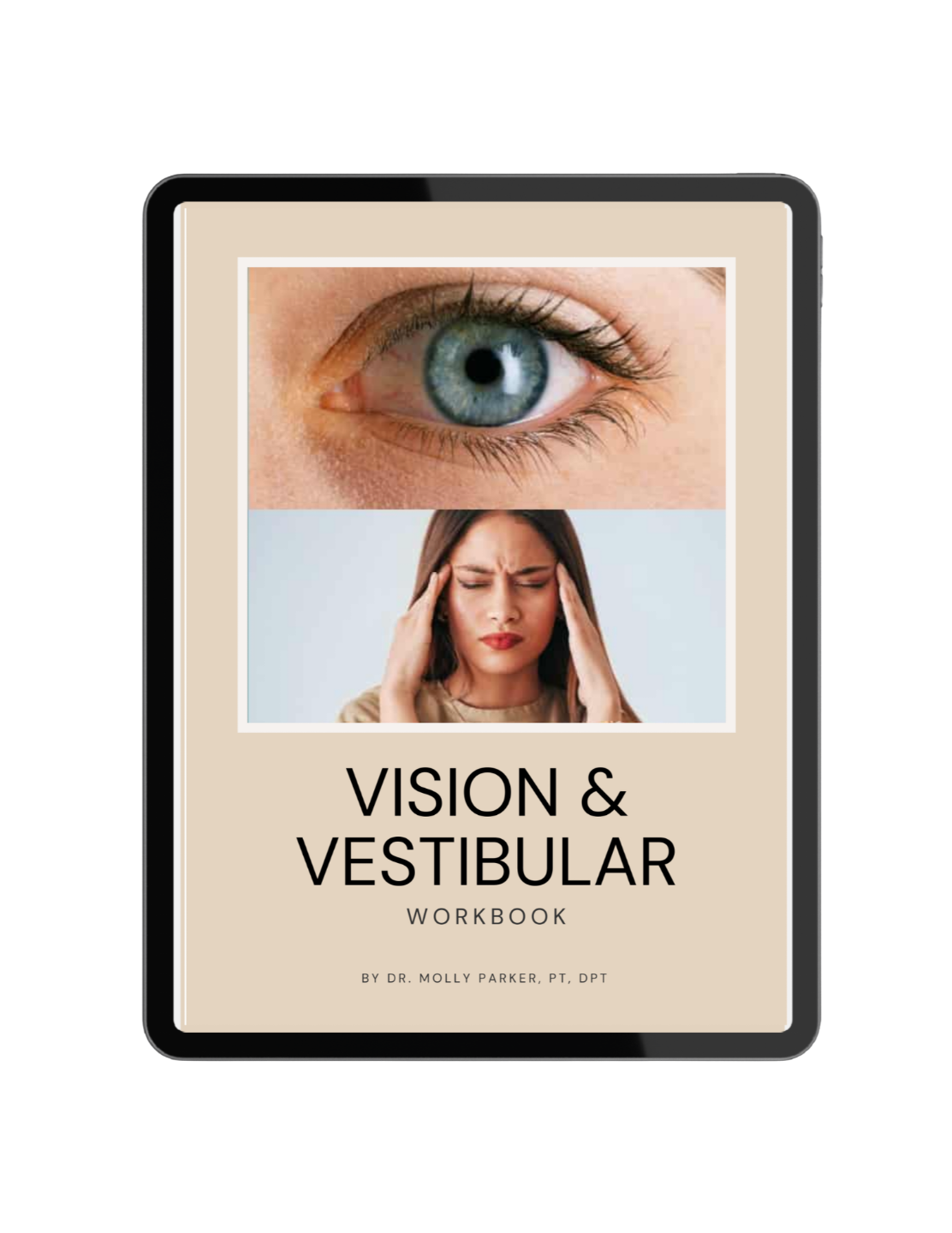
VISION & VESTIBULAR
HOME EXERCISES
Meet your Program
HIT PLAY WHEN READY
In this video we walk through how to navigate your home exercises.
*This is for educational purposes only. Consult your treating healthcare provider before changing your treatment plan.
Expand for Transcript
Meet your Program
00:00:01:04 - 00:00:19:40
Speaker 1
Hello, my friends, and welcome to the Meet Your program. Video of Your Vision Invisible Your Home Exercises. So we are at the top here and if we scroll down, this is where you are listening to me now. But I just want to give you a quick run through of what to expect in this landing page or in this exercise program.
00:00:19:40 - 00:00:37:55
Speaker 1
So you're going to see for every video you can obviously click play here if you want audio only for whatever reason, you can listen to the audio only here and then if you want a transcript, you would simply click this X to expand out the transcript for you. Now you're going to see this is split into three sections.
00:00:37:55 - 00:01:10:55
Speaker 1
So the first is ocular motor and this is all the exercises that would correspond with any symptomatic or I should say, like positive assessments for the volumes. So here you can see we have smooth pursuits. If you needed those, we have side cards, if you needed those, we have near point convergence and try to scroll slow. Here we have gaze stability or VR, same thing.
00:01:11:22 - 00:01:36:29
Speaker 1
You need those exercises. And then finally we have motion sensitivity. So we'll walk you through any motion sensitivity how to rehab that. The next section you're going to see is what's called sensory reweighting. And these were any of the exercises that came up on the modified since it. So it was those four conditions where we stood on the floor, eyes open, eyes closed, foam, no foam.
00:01:36:58 - 00:02:03:23
Speaker 1
So for any of those, if any of those came up, you will watch this video here. You can see it has audio in the transcript. Once you have completed the ocular motor section and the sensory reweighting section, you're now ready to integrate all those systems together. And so once you're ready for that, you're going to do advanced integration and you will click the exercises.
00:02:03:23 - 00:02:28:11
Speaker 1
Here. There are four exercises that are going to combine the use of your neck, your autonomic, your vision, your with your, your proprioception so that everything can begin to work together. So this is where I see a lot of things be missed. So we were really mindful in picking great exercises for you here that you can do at home and that you can progress at home fairly easily that are going to be very integrative for you.
00:02:29:38 - 00:02:47:48
Speaker 1
And then of course, at the very bottom you have the link either here or you can click the photo to your Vision and Vestibular workbook. And if you want to go to the community for any reason, you would simply click here and you can ask any questions. So go in, close your eyes, because I'm going to scroll up.
00:02:48:04 - 00:03:05:49
Speaker 1
So here we go. Okay, great. So the only other thing I would say is you can expect for each of these exercises, I gave you a level one and a level two, so I gave you the level that you can start at. And then once you get it starts to get easier for you can progress to a level two.
00:03:05:49 - 00:03:26:13
Speaker 1
So each individual exercise you're going to see, you have the level one and then the level two. So go ahead and get started on these. You have your tracker to use as you go. The other thing I would say is if you're someone who's had any heart rate issues, you can also monitor your heart rate while you're doing these exercises.
00:03:26:13 - 00:03:46:36
Speaker 1
And notice that if at any point you get a big spike, that's your body telling you to slow it down a little bit. So I find that's another really great way to kind of pull these all in together as well. And if you have any questions on that, please let me know. Otherwise, welcome. Congratulations. When you are ready, go ahead and get started on your first exercise.
Ocular Motor
Complete the exercises that came up as symptomatic during the VOMS home assessment:
SMOOTH PURSUITS
HIT PLAY WHEN YOU ARE READY
Smooth pursuits are the eyes ability to track smoothly and together.
*This is for educational purposes only. Consult your treating healthcare provider before changing your treatment plan.
Expand for Transcript
Smooth Pursuit
00;00;00;14 - 00;00;35;28
Speaker 1
Hi. Welcome to at your home exercises for smooth Pursuits. So we're going to start with level one before diving into level two. And level one is super simple. Oftentimes the thing we use to assess is the thing that we then turn into treatment. So that's what we're going to do here. You have two options. Your first option is you can just use your pen like before, and you're going to move either if you need it to be much slower, you can write to left and then you're going do the same thing up and down.
00;00;35;28 - 00;01;02;10
Speaker 1
You can do this until your symptoms feel like they're starting to increase more than two points, or I would say about 5 to 10 repetitions, whichever comes first. The other way you can do this is you can use your page in your workbook that just has this long dark line on it and you'll tape it at eye level onto a solid surface.
00;01;02;11 - 00;01;37;14
Speaker 1
So something that doesn't have a lot of pattern behind it. Right. And then all I want you to do is sit about three feet in front of it and you're going to track it with your eyes. So I'm using my eyes to track right to left. And again, you can do this for up to about 2 minutes. I would say if the speed we initially went out was too quick, you can slow it down or you can do it for a shorter duration or both.
00;01;37;24 - 00;01;58;02
Speaker 1
But the goal is to be able to work at a pretty, I would say, about this speed back and forth and feel like you can keep your eyes firmly on track. Everything stays clear in focus and you're able to do that. You should be able to do that for about 2 minutes. So once you get to that point, you'll be ready to progress to level two.
00;01;58;17 - 00;02;16;15
Speaker 1
And level two is primarily going to be in your workbook. So you're going to see a few pages here. We have a couple of mazes, so this will be one. And you can see we've got a tree, we've got a fish. So the idea here for each of these is you would also then put these up on the wall.
00;02;16;26 - 00;02;47;21
Speaker 1
So I'm going to go in and start with my bird because that's a little easier. One. And I'm going to just take my my take from before. But you can have whatever type you want on it, but again, I'm just going to tape it about three feet in front of me at eye level. And what I'm going to do is use and follow that maze with my eyes trying to stay in the white portion.
00;02;48;15 - 00;03;15;01
Speaker 1
So it's just going to look like I'm starting with the bird and I'm tracing with my eyes through the white portion of the maze. And I'm going to continue this until either my symptoms reach over two points or I eventually make it to the tree. The goal for this one will be to be able to complete the whole maze without increase of symptoms.
00;03;15;09 - 00;03;44;08
Speaker 1
Once you've finished that one, you can then move on to this other one and then once you have finished the mazes, you can do the final one, which is what's called twin lines. So you're going to see multiple pages in your workbook that look like this. And I can just show you there's a few different ones. Now you'll notice I labeled them easy medium and hard because they have an increasing number of lines.
00;03;44;22 - 00;04;07;03
Speaker 1
But what you're going to do for each one of these is you will also put it on the wall right in front of you in sitting, and you're going to start with a and you're going to follow the line until you get to the animal. That starts with a which is the at once you're able to do that, you'll do B, you'll follow that line until you get to the animal that starts with the B, which is the bear.
00;04;07;23 - 00;04;28;13
Speaker 1
Now, again, you'll do this to either to completion or until you start to feel like either your symptoms increased more than two points or I would say for this one or really any of the other ones, you feel like you're starting to fatigue to the point where you're losing the quality of it. You're not really able to keep on that line and move smoothly.
00;04;28;13 - 00;04;48;17
Speaker 1
Maybe you're starting to fall off of it, or you're needing to feel like you need to blink a lot or anything where it feels like the quality of the movement just isn't quite what it is. That would also be a good stopping point. Any end you can do through all of these until you feel like you've done the easy, medium and hard and you're able to do those well.
00;04;48;17 - 00;05;17;12
Speaker 1
So that is level one and level two of smooth pursuits. Go and get started on these and then let me know if you have any questions. Again, level one you want to be able to do about this speed for 2 minutes using your tracking. And then level two, you're going to be able to want to get through the mazes and through the twin lines with good quality of movement at a good pace without increase of symptoms.
00;05;17;12 - 00;05;21;02
Speaker 1
And then once you're there, we know that you're smooth pursuits are much better.
SACCADES
HIT PLAY WHEN YOU ARE READY
Saccades are the eyes ability to jump between points of focus.
*This is for educational purposes only. Consult your treating healthcare provider before changing your treatment plan.
Expand for Transcript
Saccades
00;00;00;09 - 00;00;18;19
Speaker 1
Hello and welcome to Saccades. Saccades are those jumping eye movements where your eyes are able to move from one thing to another and they stay clear and in focus and easy peasy. This often shows up with reading, so a lot of people need to work on the cards. So level one, there's a couple of ways to do this.
00;00;18;20 - 00;00;42;07
Speaker 1
One, you can just use again, like we talked about with smooth pursuits. Often the thing that we use to assess is the same thing that we use to treat it. And that can be true here. So we can start with the cards again, just with our hands out in front of us, our thumbs up, just as we did before sitting and then you can start at what pace feels comfortable but challenging.
00;00;42;08 - 00;01;05;24
Speaker 1
So you would move your eyes from your left thumbnail to your right thumbnail back and forth. Now, eventually we want to get this to the pace of about 50 beats per minute, and if you're not sure what that is, use a metronome app. And we want to be able to do that for about a minute. But as you're working up, you can start slower.
00;01;06;09 - 00;01;31;04
Speaker 1
We're going to start seated. You can start we have a few cutouts here. So your other option is you can move your fingers a little closer or a little further apart if you need to start there. And then we want about this distance in the end. Your other option, if you don't want to use your thumbs, is you probably notice in your workbook, you have a page that looks like this that has two dots on it.
00;01;31;19 - 00;01;53;22
Speaker 1
Since we know that part of rehab is fun and joy, I wanted you to have a couple other options to cycle to. So for all women. George Clooney, you can see the card back and forth to him. If you're looking for a bit younger, you can see the card back and forth to Michael B Jordan. Back and forth.
00;01;53;22 - 00;02;17;26
Speaker 1
It's that pretty face. Maybe you prefer the ladies. You can see card back and forth to Margot Robbie or finally again for the younger gentleman. You can see the card back and forth to take. So pick which one you want. Make it a little bit fun. We want to bring some joy into these things. But what you're going to do is you're going to put it on the wall in front of you.
00;02;18;05 - 00;02;34;07
Speaker 1
Again, not a busy background, just a plain background. I just have this up with tape. You're going to sit about three feet in front of it. And just like I was doing with my thumbs, you're going to do that with your eyes. So you're going to I'm going to do the dot on the left. The dot on the right.
00;02;34;15 - 00;03;03;14
Speaker 1
Or maybe it's George Clooney left. George Clooney. Right. And again, you're going to go at whatever pace feels comfortable but challenging and slowly increase it until you're able to get about that 50 beats per second pace for about a minute. That's where we know you're okay. Your other option is you can cut each of these squares or each of these circles out, and you can place them a little further apart or a little bit closer.
00;03;03;20 - 00;03;26;12
Speaker 1
That works, too. Typically, we don't second more than about, I would say, this far apart, but you can move those a little bit too, if you need. Yeah, and that's the basic level one of the cards. Now, once you get that, we want to move you up to level two because we want you to be able to do things like watch sports, read a book, all of those kinds of things.
00;03;26;12 - 00;03;48;00
Speaker 1
So level two, you're going to see in your workbook two things. You're going to have what's called alphabets two cards, and you're going to have what's called bug jumps. So it's these pages here. You'll start with alphabets, the cards, and you'll just have this on a table right in front of you and you'll need a pen or pencil.
00;03;48;25 - 00;04;12;10
Speaker 1
And you can see here, all that you're going to do is it says, we'll start with cake. So big you're going to underline any letter that's a C, So you're going to follow along here. I see a C underline. Keep going. C, underline, keep going, C, underline. Hop to the next line, continue all the way down through the bottom.
00;04;12;22 - 00;04;35;27
Speaker 1
I have given you a couple rows here, so there's some on this page. There's a couple more on the others. The goal here is I'd like you to be able to do this whole strip without increase of symptoms or again, feeling like you lose that quality of movement where you're not able to jump. Well, when you jump, it feels blurry or you really start to fatigue or you feel symptoms.
00;04;36;04 - 00;04;54;27
Speaker 1
Anything like that lets us know there still a little bit of work to be done. So you'll stop either when you feel like you're losing the quality of movement, your symptoms increased more than two points. Or if for whatever reason you feel like you're done that day, but you will do these until you can get through the full line.
00;04;55;11 - 00;05;30;09
Speaker 1
Symptom free, Great quality of movement. Now, once you're finished with that, the last two cause I want you to do is called bug jumps. So you're going to use hold on this page in your workbook where it says the chord bug jumps. Now, these are computerized, so there's a couple of things they're going to do. One, you're going to have a slow where you'll start and then you're going to progress to the fast and what you're going to see when you click either here or use the QR code is you're going to see little ladybugs jump across the screen.
00;05;30;26 - 00;05;51;27
Speaker 1
And what I want you to do is follow those with your eyes so your head stays still. Just watching the bug jump across the screen. Same rules of engagement here, right? You want to be able to do about the fast ones for at least about a minute. And then we know you're good. You will stop at any point.
00;05;51;27 - 00;06;15;29
Speaker 1
If you lose the quality of movement, you get symptoms or you feel like you're starting to fatigue and get sloppy kind of thing and you'll gradually increase up each day. So that's how these work that is. SECONDS There are so many fun ones we can do here. So if you want more ideas, please let me know. But here is a very good level one and then level two of how to work on your six eye movements.
00;06;16;07 - 00;06;17;09
Speaker 1
So see you next time.
NEAR POINT CONVERGENCE
HIT PLAY WHEN YOU ARE READY
Convergence is the ability of your eyes to come together to view an object up close.
*This is for educational purposes only. Consult your treating healthcare provider before changing your treatment plan.
Expand for Transcript
Near Point Convergence
00;00;01;05 - 00;00;18;02
Speaker 1
All right. So now we're going to do near point of convergence. And so this is can your eyes come together and can they look at an object that's up close? And this, of course, is really important in reading and in life. So just like with the other ones, oftentimes the way we test these is the way we treat it.
00;00;18;02 - 00;00;35;15
Speaker 1
So what we're going to do here is use either a popsicle sticker, a tongue depressor. This has some letters written on it, which we might have you do as well. Or this is just a little one I got online. Or you can use a pen as long as it has some writing on it that you can look at.
00;00;35;15 - 00;00;57;06
Speaker 1
So any of those three will do. And this one is, remember, for anyone who has more than six centimeters of convergence. So if you were able to get 5 to 6 centimeters or less, you're good to go. You don't need to do this one if you were able unable to and you had a higher measurement, this is going to be for you.
00;00;57;07 - 00;01;13;01
Speaker 1
So what we're going to do is I'm going to use my something on my tongue depressor. So I'm going to use my tongue depressor here. And again, I'm going to hold it out at arm's length and I'm going to look at the m on the top of my tongue depressor. So for you, you can write any letter you want there.
00;01;13;01 - 00;01;38;11
Speaker 1
But I'm going to look at my arm here and I'm going to start bringing it close to my nose here. Now, let's say, for example, at this point, it started to split into double. That means my eyes aren't able to converge properly, so I'm going to move it just a little bit back and then I'm going to work in that range and I'm just going to practice here.
00;01;38;11 - 00;02;13;26
Speaker 1
Once that's feeling stable, I might try that and to move it a little bit more forward. So I'm splitting about here. I'm going to move it back just a bit to where I can get a single image nice and clear, and then I'm going to practice in this range. So the goal here is to be able to work up to the point where you can get within 5 to 6 centimeters of your nose, where the letter on either the tongue to pressure or on the pen stays nice, clear, sharp and single.
00;02;13;27 - 00;02;33;12
Speaker 1
You don't want any double images or blurring. This is one that you can practice again until you start to feel either symptoms increase or you're starting to feel like you're losing the quality of the movement or it's getting harder or something like that is usually a good time. That saying, okay, that those eyes are fatigued. Let's take a little break and come back to it again.
00;02;33;12 - 00;02;44;19
Speaker 1
So you're going to do this until you can get to that 5 to 6 centimeter mark. And this one's simple. It's level one, two, three and four. So give this one a shot and let me know if you have any questions.
GAZE STABILITY (VOR)
HIT PLAY WHEN YOU ARE READY
The vestibular ocular reflex (VOR) keeps your vision stable as you move through the world. This is also referred to as gaze stability.
*This is for educational purposes only. Consult your treating healthcare provider before changing your treatment plan.
Expand for Transcript
Gaze Stabilization (VOR
00:00:00:14 - 00:00:26:13
Speaker 1
So now we're going to go into a gaze stabilization. This is also referred to as VOR, which is your vestibular ocular reflex. So this is the thing that happens between the eyes and the neck so that when you're walking in the world, the world stays steady. So we're going to do, of course, level one and level two. So level one is just going to be either your thumb or you can have a sticky note with a little X on it.
00:00:26:28 - 00:00:51:26
Speaker 1
So option one for this level first is just going to be arm straight out eyes on the X, and then you're turning your head, keeping the X clear. Now I want you to start slow and then gradually increase to where you're still able to keep the X clear and your symptoms are increasing more than two points on a ten point scale.
00:00:52:06 - 00:01:14:19
Speaker 1
So eventually I want you to work r yourself all the way up to 120 beats per minute. So let's put that on the metronome and see what that looks like so you can see it's a pretty good clip. So this is too much in the beginning. Feel free to slow it down, but this is where you're going to want to get to.
00:01:14:19 - 00:01:39:12
Speaker 1
You want to be able to do 120 beats per minute for at least 1 to 2 minutes to progress. Now, if you're holding your arm out and you're like, you know what? That's bothering my shoulder. It's bothering my neck. You can also just stick this sticking out onto a wall in front of you at eye level and do something about, again, arm's length and do the exact same thing here.
00:01:40:15 - 00:02:07:21
Speaker 1
Notice I can do side to side and then I can also do up two down. So level one is going to be arm or sticky note, slow moving too fast. You want to get to 120 beats per minute on a metronome for at least 1 to 2 minutes keeping that x clear. Now, once you're able to do that, we're going to go to level two and level two is going to be the same thing.
00:02:07:28 - 00:02:27:00
Speaker 1
But now we're going to be moving. So here's what it's going to look like. Okay, So for level two, we're going to add in some forward walking and some backward walking. So we're going to do the same thing as we did before where you're going to start slower and then gradually increase the pace until you're at 120 beats per minute for at least 2 minutes.
00:02:27:00 - 00:02:45:21
Speaker 1
We say 1 to 2, but I'd like you to get to 2 minutes. Ideally keeping that X clear so it's going to look like this. We're going to have your hands straight out in front of you. I have my eyes on the X and I'm going to walk forward keeping that X clear, and then I'm going to walk backwards, keeping that X clear again.
00:02:45:21 - 00:03:07:09
Speaker 1
I'm going to move at a pace where I feel like I can again keep the x clear. So if my head needs to move slower to start, it can and then eventually I'm going to speed it up there. Okay, So the goal is be able to walk forward and backwards, do that 120 beats per minute, 2 minutes, keep that X clear.
MOTION SENSITIVITY
HIT PLAY WHEN YOU ARE READY
Visual motion hypersensitivity also referred to as visual vertigo, is a sensory mismatch between perceived movement in the visual field and vestibular input of head motion.
*This is for educational purposes only. Consult your treating healthcare provider before changing your treatment plan.
Expand for Transcript
Motion Hypersensitivity
00:00:00:03 - 00:00:23:02
Speaker 1
So now we're going to talk about visual motion sensitivity. This is also called motion sensitivity. Motion hypersensitivity. You can also hear this called visual vertigo or all talking about the same thing. So just like with the other two, we're going to do with level one and level two here and essentially with with these, we're going to do gradual exposure.
00:00:23:03 - 00:00:46:14
Speaker 1
So level one is going to be getting you used to things in your visual environment, passing by you. So level one is literally going to be either on a treadmill or outside in a non busy environments, maybe just in your neighborhood or in a park or something where it's fairly calm. I just want you to walk and notice the world around you.
00:00:46:16 - 00:01:16:17
Speaker 1
You can come out a slow pace. It can be whatever feels comfortable for you. Now, if you're doing that and you're starting to get that dizziness, nausea, sensation, you can pull in some of the chords. So remember, the chords are going from one thing to another with your eyes so you can be out on your walk. Maybe you start to feel yourself getting a little dizzy and you can cycle between some of the trees ahead of you, or a sign or anything like that can really help.
00:01:17:00 - 00:01:42:04
Speaker 1
I'll also say when you're still on level one, if you're going through your home exercises and that VR gaze, stabilization feels like too much sometimes that's a little too yucky right away for people with motion sensitivity. So you can pause that. Keep focusing on your smooth pursuits and the chords if you did need them. And then as you progress, then you can pull back in the case stabilization and that might feel a little better for you.
00:01:42:14 - 00:02:07:22
Speaker 1
So level one is simply going to be walking in a familiar, fairly low stimulus environment and just taking in the world around you, doing a few seconds if you get sick. Now, once you can do that, let's say for 5 to 10 minutes or so, you're going to move on to level two. And in level two, we're going to put you in a more stimulating environment and we're going to match that environment to whatever it is that's bothering you.
00:02:07:23 - 00:02:33:16
Speaker 1
So you're going to notice you have this sheet in your workbook says visual motion sensitivity, and you're going to see that you have options for multiple levels here. Now, I did put a level one, so say you either want to start low or it's winter and you can't walk and it's too icy, whatever it may be. Level one is just a video of someone walking in an environment.
00:02:33:16 - 00:03:00:03
Speaker 1
So you would start there Once that feels easy breezy for you, you're like, This isn't really too challenging. It's not very symptom provoking. You're going to go to level two and that's a more visually busy environment. Once you hit those, you're going to then go to level three on here is anything that's specific for you. So you're going to notice I have a busy environment, so say you're getting motion sensitivity in the grocery store.
00:03:00:14 - 00:03:24:24
Speaker 1
We're going to do a video of you looking at the store. If let's say you get visual motion sensitivity with driving, you're going to do a video where it's driving and then you're going to see at the bottom of the sheet there is an entire air. And these are called kinetic videos. There is an entire opto, kinetic playlist that really has every single snare you can imagine, escalators, anything that might be causing you symptoms.
00:03:24:24 - 00:03:50:08
Speaker 1
You can use these videos. The idea is I want you to be able to watch them and be able to do so without getting increase symptoms. So just like everything else, you're going to start with what you can and gradually increase until you can finish the video for whatever the scenario is that is bothering you. Now, if you have any questions or you need more guidance here, please feel free to ask questions in the community.
00:03:50:27 - 00:03:55:01
Speaker 1
But that is your visual motion sensitivity. Whole exercises.
2
Sensory Re-Weighting
Complete the exercises that came up as symptomatic during the mCTSIB assessment:
SENSORY RE-WEIGHTING
HIT PLAY WHEN YOU ARE READY
Now that you have assessed which sensory systems (vision, vestibular and somatosensory/proprioception) are not working properly it is time to retrain all three to optimal function.
*This is for educational purposes only. Consult your treating healthcare provider before changing your treatment plan.
Expand for Transcript
Sensory Re-Weighting
00:00:00:11 - 00:00:23:22
Speaker 1
Welcome to level one of sensory reweighting. So now that you've done the whole assessment and you've tested all four conditions, you now have an idea of which condition conditions you were not able to make it to 30 seconds on. So level one is simply going to be doing whatever conditions. You did not make it to 30 seconds practicing that until you do.
00:00:24:06 - 00:00:46:09
Speaker 1
So say you were able to do conditions two, three and four. You would do each one of those. Practice it each day until you're able to do it for 30 seconds without your arm or your leg moving and your symptoms increasing. More than two points on a ten point scale. Now, have a little tip for you here. If you're doing your conditions and at one point you notice you're not.
00:00:46:09 - 00:01:07:26
Speaker 1
Every time I'm doing this, I always lean to the same side. That might be the orderlies in your inner ear, not giving enough input of where they are in space. And so a little tip that was passed on to me from a colleague that I want to pass on to you is adding a little grab reception. So let's say, for example, I'm doing my conditions and I'm like, you know what?
00:01:07:26 - 00:01:21:15
Speaker 1
I always lean to the right. What you can do is take a weight. So I have a £5 weight and you're going to put it on the opposite side of where you lean. So if you're always leading to the right, you're going to put it on the left. If you're always leaning to the left, you're going to put it on the right.
00:01:21:23 - 00:01:42:03
Speaker 1
Maybe you're always leaning forward. So you're going to put it behind your back or you're always leaning back. You're going to put it in front of you. Whatever direction you consistently lean, you're going to do it on the opposite. And consider this a primer before you start doing your level one conditions. So let's say I'm always going to the right.
00:01:42:04 - 00:01:58:10
Speaker 1
So I'm going to say, okay, before I do my conditions today, I'm going to take a weight and I'm going to put it on the opposite side. So for me, that would be my left. And I'm going to see if my body balance itself out a little bit. My body personally loves this one, so it'll really balance itself up quite nicely.
00:01:58:22 - 00:02:27:13
Speaker 1
You can do eyes open or closed, whatever feels good for you and maybe give 10 to 20 seconds of just that little extra gravity input. Once you've got that done, you can put the weight down and you can begin practicing whatever conditions you needed for that day. Once you're able to do all conditions for 30 seconds without your arm or your leg moving and your symptoms increasing, more than two points on a ten point scale, you're ready to go to level two.
00:02:27:13 - 00:02:53:11
Speaker 1
So when you're ready, I'll see you there. Okay, Here's a level two of sensory. We wait re waiting. Now that you can do all the conditions on the floor, on the foam, eyes open, eyes closed, we're going to challenge you one level further. So what you're going to need is either your phone box or your pillow, whatever you're using before, and then maybe 4 to 5 household objects that have a little height to them.
00:02:53:11 - 00:03:16:21
Speaker 1
So whatever you want to put there, they can be cans of soup, whatever you need. And what you're going to do is start standing on the left foot, little bending the knee, especially for my hyper mobile people. And you're just going to tap the cones ahead of you. Now you can start coming back in between or using. I was even a little hard for me.
00:03:16:21 - 00:03:40:26
Speaker 1
Or you can keep the foot out and tap the cuts. Once you're able to do that, sliding your switch to the other and I want you to be able to do this on both sides for 30 seconds without falling or getting symptoms, more than two points on the ten point scale.
Advanced Integration
Once you have completed the ocular motor and sensory weighting exercises you are ready to fully integrate all your systems. Click on the advanced integration video below to get started:
ADVANCED INTEGRATION
HIT PLAY WHEN YOU ARE READY
In the final phase of this home exercise program we'll integrate all your systems (neck, autonomics, vision, vestibular and proprioceptive) together- leaving you feeling a heck of a lot better.
Timestamps:
0:01 Walking with head Turns
2:38 Balloon Toss
5:04 Cone Tap Turns
7:22 Chops
Lights mentioned in video: Tap It Lights- link HERE
*This is for educational purposes only. Consult your treating healthcare provider before changing your treatment plan.
Expand for Transcript
Advanced Integration
00:00:05:21 - 00:00:07:25
Speaker 1
So your first integration exercise, we're going to.
00:00:07:25 - 00:00:15:08
Speaker 2
Do something that we do in the clinic all the time and it's simply walking with head turns. So now that we've gotten all the pieces in place.
00:00:15:16 - 00:00:21:12
Speaker 1
We're going to start to integrate them all together in a way that really makes sense for your everyday life. Now we're adding in.
00:00:21:12 - 00:00:22:06
Speaker 2
The neck a little bit.
00:00:22:06 - 00:00:23:11
Speaker 1
Here, and for anyone.
00:00:23:11 - 00:00:28:22
Speaker 2
Who's had neck proprioception issues, I've added a laser so you can use the same.
00:00:28:22 - 00:00:30:08
Speaker 1
Laser you use for your neck.
00:00:30:08 - 00:00:46:21
Speaker 2
Proprioception exercises on your head here too. So I'm going to go and turn mine on. And all it is is it's going to be walking with head turns. And then once you've got that, we're going to add in a dual task. So if you have a long walkway in your.
00:00:46:21 - 00:00:47:19
Speaker 1
House or a long.
00:00:47:19 - 00:00:53:21
Speaker 2
Hallway, that's ideal. To demonstrate this, I'm in kind of a short space. Ideally, I'd do a little bit.
00:00:53:21 - 00:00:54:25
Speaker 1
Of a longer space.
00:00:54:25 - 00:01:07:25
Speaker 2
At home, so I'm going to step back here. All it's going to be is walking at a normal pace and then I'm going to turn my head various ways. Now, any time I turn my head, I want to focus on an object and I want the.
00:01:07:25 - 00:01:08:24
Speaker 1
Laser to.
00:01:08:24 - 00:01:12:04
Speaker 2
Hit that object. So say I'm trying to look right at.
00:01:13:00 - 00:01:16:08
Speaker 1
There's a little circle thing on the wall here. I'm pointing my laser right.
00:01:16:08 - 00:01:25:15
Speaker 2
At that spot. Say, I turned and I wanted to hit this sticky note. I would turn and look and I'd hit my laser right at that spot. So that way.
00:01:25:15 - 00:01:26:20
Speaker 1
You're coordinating.
00:01:26:20 - 00:01:33:26
Speaker 2
Your neck with the motion. Now, once you have that down, you're going to do the exact same thing.
00:01:33:26 - 00:01:34:05
Speaker 1
But you're.
00:01:34:05 - 00:01:38:06
Speaker 2
Going to add what's called a dual task. This is going to make it a little harder.
00:01:38:06 - 00:01:39:07
Speaker 1
Because your brain is now.
00:01:39:07 - 00:01:48:21
Speaker 2
Having to divide its attention between two things. And that usually pulls out any little things that need to be cleaned up. So for art, we'll task.
00:01:48:21 - 00:01:49:06
Speaker 1
We're going.
00:01:49:06 - 00:01:50:03
Speaker 2
To use.
00:01:50:14 - 00:01:54:01
Speaker 1
Numbers. So we're going to start with 100 and we're going to subtract.
00:01:54:06 - 00:01:56:18
Speaker 2
Let's see, let's start with one and let's.
00:01:56:18 - 00:01:57:18
Speaker 1
Add three.
00:01:57:28 - 00:01:58:20
Speaker 2
As we go.
00:01:58:29 - 00:02:00:21
Speaker 1
So again, you're going to have a longer.
00:02:00:21 - 00:02:15:12
Speaker 2
Walkway, but it would be one, four, seven, so on. So you can add in, you're walking with head turns and your dual task, which is math, again, longer run way than I have here.
00:02:15:12 - 00:02:17:21
Speaker 1
But it's a really great way to start to integrate.
00:02:18:01 - 00:02:24:00
Speaker 2
Those systems. I'd like you to be able to do that. Let's say maybe two sets of 15.
00:02:24:00 - 00:02:24:16
Speaker 1
To 30.
00:02:24:16 - 00:02:25:29
Speaker 2
Seconds without.
00:02:25:29 - 00:02:26:16
Speaker 1
Your symptoms.
00:02:26:16 - 00:02:42:26
Speaker 2
Increasing more than two points and your neck accurately hitting anything that you're turning to. All right. So give that a try and let me know if you have any questions.
00:02:42:26 - 00:02:43:23
Speaker 1
Your next integration.
00:02:43:23 - 00:02:45:11
Speaker 2
Exercise is a fun one. You can.
00:02:45:11 - 00:02:45:27
Speaker 1
Either.
00:02:45:27 - 00:02:54:26
Speaker 2
Use a balloon or you can use some sort of a small ball. I like the balloon because it goes a little bit slower and we can write.
00:02:54:26 - 00:02:55:28
Speaker 1
Different letters.
00:02:55:28 - 00:02:58:28
Speaker 2
On the balloon. So as we're tapping it, we can add in the.
00:02:58:28 - 00:03:04:12
Speaker 1
Extra visual integration. So super simple. We're going to start setting.
00:03:04:12 - 00:03:04:21
Speaker 2
You can.
00:03:04:21 - 00:03:06:08
Speaker 1
Set your couch wherever you.
00:03:06:08 - 00:03:26:29
Speaker 2
Want to be and you're just going to have your balloon and you're going to tap. Let me do better than that. I'm going to tap up high and then I'm just going to keep my eyes on whatever letter is popping up so I can see the H. I can see this t, I see another t. I put the concussion.
00:03:26:29 - 00:03:29:07
Speaker 1
Hub on here, guys. And you're going to.
00:03:29:07 - 00:03:49:01
Speaker 2
Keep doing that until you feel your symptoms start to increase more than two points. Ideally, you should be able to do this for about a minute or two without feeling any worse. Now, if looking at the letters feels too much, maybe you just start tapping the balloon. If tapping too high feels like too much, maybe you just start with little taps like this.
00:03:50:00 - 00:03:53:28
Speaker 1
And then eventually work up to some bigger taps and then bigger taps with the letter.
00:03:54:15 - 00:03:57:03
Speaker 2
If you're like, I don't have a balloon, just tell me what.
00:03:57:03 - 00:03:58:13
Speaker 1
I can use around my house.
00:03:58:17 - 00:04:09:20
Speaker 2
Grab any ball, any small ball, and you can just toss it up. Now, this one has a weird shaped logo on it, so you can look at that. If that were to show up, I could.
00:04:09:20 - 00:04:11:29
Speaker 1
Also write letters in a sharpie.
00:04:11:29 - 00:04:19:15
Speaker 2
On this ball too. Or I can just simply practice tossing it up and down and watching it with my eyes.
00:04:20:08 - 00:04:22:25
Speaker 1
So really great integration exercise.
00:04:22:25 - 00:04:39:17
Speaker 2
If you love this one and the sitting gets too easy and you want to make it harder, do the exact same thing. Standing up. If standing up becomes too easy, you can even start doing it on your full balance. BLOCK Or if you have a balance board at home, you can do it on that, too.
00:04:40:21 - 00:04:43:12
Speaker 1
This is a really, really great exercise to integrate many things.
00:04:43:12 - 00:04:47:28
Speaker 2
So start seated. Small, increase the amount.
00:04:48:12 - 00:04:49:20
Speaker 1
Add letters.
00:04:49:27 - 00:04:58:15
Speaker 2
Once that gets too easy, do it. And standing once that gets too easy. If you're still loving it, do it on a phone box or a balance board.
00:04:59:02 - 00:05:00:23
Speaker 1
Really, really great. In our integration.
00:05:00:23 - 00:05:08:08
Speaker 2
Exercise.
00:05:08:08 - 00:05:09:07
Speaker 1
So for this integration.
00:05:09:07 - 00:05:20:25
Speaker 2
Exercise, this is going to be the one where you're like, If I'm every time I do the dishes or every time I'm like doing things around the house, I start to feel sick or I'm playing with my kids or whatever it may be.
00:05:21:08 - 00:05:22:13
Speaker 1
This is a really great one.
00:05:22:13 - 00:05:25:22
Speaker 2
So again, you can use calls if you have them, or you.
00:05:25:22 - 00:05:26:23
Speaker 1
Can literally use.
00:05:26:23 - 00:05:35:12
Speaker 2
Household objects of different colors. But what this is going to look like is I'm going to tap the cone at my height. So maybe you have a countertop here or maybe you.
00:05:35:12 - 00:05:36:18
Speaker 1
Have a dresser, a desk.
00:05:36:18 - 00:05:48:13
Speaker 2
Whatever it may be, and then I'm going to tap the column so I have a green one here. Come up, tap, tap. Maybe I'm just doing these.
00:05:48:13 - 00:05:49:23
Speaker 1
In order first.
00:05:50:25 - 00:05:55:08
Speaker 2
Maybe to make it harder, I start tapping them in alphabetical order.
00:05:56:08 - 00:05:58:25
Speaker 1
So green for G.
00:05:59:28 - 00:06:08:10
Speaker 2
Have to literally think, Oh, no, my dad's blue. Blue is first, then green, then it would be orange. Oh.
00:06:09:18 - 00:06:10:15
Speaker 1
And then red.
00:06:10:15 - 00:06:29:06
Speaker 2
So you could do it that way. You could also have someone calling out colors and you could mix it up that way. You can do this on whatever side. These kind of things feel provoking. So maybe my table is over on this side, or maybe I do them on both. You can again do these exercises as you're able.
00:06:29:06 - 00:06:30:12
Speaker 2
Once you start to feel your.
00:06:30:12 - 00:06:31:17
Speaker 1
Symptoms increase.
00:06:31:17 - 00:06:37:19
Speaker 2
Within about two points. The other thing I love to do with something like this is if you might have seen the videos around social media or maybe.
00:06:37:19 - 00:06:39:07
Speaker 1
Even at your physical therapy office.
00:06:39:15 - 00:06:55:28
Speaker 2
Where they have Blaize pods, which is those little round lights that light up where you could then turn on the game and you could hit the light here, another one would light up, you could hit it down there. That's super fun for these two. I wanted to show you just an easy at home version so you don't feel like you need to get more things.
00:06:56:07 - 00:06:59:00
Speaker 2
But if you're looking for something for home that is.
00:06:59:00 - 00:07:00:08
Speaker 1
Just really worth it.
00:07:00:27 - 00:07:01:17
Speaker 2
I think Blaize.
00:07:01:17 - 00:07:02:11
Speaker 1
Pods are great.
00:07:02:11 - 00:07:07:26
Speaker 2
There's also a more inexpensive version on Amazon that I'll link below called Fit Lights.
00:07:07:26 - 00:07:11:10
Speaker 1
Those are like $30 blaze pods or like $400.
00:07:11:10 - 00:07:13:05
Speaker 2
So those are.
00:07:13:05 - 00:07:14:18
Speaker 1
Really great to incorporate.
00:07:14:18 - 00:07:24:01
Speaker 2
Into things like this as well.
00:07:24:01 - 00:07:25:04
Speaker 1
For your next integration.
00:07:25:04 - 00:07:35:22
Speaker 2
Exercise, I want to introduce you to Chops so you can use this with a weight. You can use this with a one of those big balls at the gym. You can do it with a weighted ball. But here's the idea.
00:07:35:22 - 00:07:36:20
Speaker 1
So what you're going to do.
00:07:36:20 - 00:07:50:06
Speaker 2
Is you'll start, let's say let's go left right, and you're going to squat down, keeping your eye on the weight and then chop up across your body, keeping the eye on the weight, squat down, eyes up so you can see them starting.
00:07:50:06 - 00:07:51:08
Speaker 1
To integrate head.
00:07:51:08 - 00:07:55:12
Speaker 2
I body and changes in position.
00:07:55:12 - 00:07:56:21
Speaker 1
So this is a really great one.
00:07:56:21 - 00:07:58:27
Speaker 2
If you're someone who's on the.
00:07:58:27 - 00:07:59:07
Speaker 1
Later.
00:07:59:07 - 00:08:01:06
Speaker 2
Stages of the ADAPT protocol.
00:08:02:03 - 00:08:03:26
Speaker 1
It's a really great integration exercise.
00:08:03:26 - 00:08:22:19
Speaker 2
The other way you can do this is with a ball, so I'm going to use a little tennis ball, but if you have one of those big balls at the gym, I really like those too. So again, you can have the ball, you can come down, you can toss it, look, and you can mess it up and then you can try it again.
00:08:22:19 - 00:08:29:00
Speaker 2
So you can come down, you can toss it against the wall, catch that down.
00:08:29:00 - 00:08:30:07
Speaker 1
I prefer a bigger ball.
00:08:30:07 - 00:08:43:26
Speaker 2
With this because you can just chuck it and then have it back down. But you can use this ball instead. So you would do left, right and then you would do right to left. Let's say maybe two sets of 15.
00:08:43:26 - 00:08:44:14
Speaker 1
Or so.
00:08:45:08 - 00:08:49:08
Speaker 2
Work up to that. If you're getting symptoms more than two points.
00:08:49:08 - 00:08:50:16
Speaker 1
Or you're getting like really dizzy.
00:08:50:16 - 00:08:53:18
Speaker 2
Things like that, you can start with maybe two sets of.
00:08:53:18 - 00:08:54:15
Speaker 1
Three or.
00:08:54:15 - 00:09:05:03
Speaker 2
Whatever it may be, and you're going to work up to two sets of 15 again, you can use a weight, you can use a ball, you can keep it in your hands or you can toss it against the wall and catch it again.
00:09:05:19 - 00:09:08:00
Speaker 1
All of those are really great to start to integrate all your.
00:09:08:00 - 00:09:10:11
Speaker 2
Systems together, so give it a try.
THE VISION & VESTIBULAR WORKBOOK
If you haven’t yet, download your workbook to support your home exercise program. Click above or on the workbook photo to be taken straight there.
And of course myself and this community are here to support you every step of the way. Head to the community HERE.